Systems that .
Your competitors are using AI. You're still in meetings about it. Resilien designs adaptive AI systems — architecture, not tools. What's moving behind this text is live: every particle is responding to you right now.
We learn how your business runs.
Then we implement what others miss. Not where the org chart says decisions happen — where they actually happen. Meetings, dashboards, spreadsheets, the conversations that move the business.
Four disciplines. One living system.
Map the operation. Find the opportunities.
We start where the organization actually runs — meetings, dashboards, spreadsheets, the conversations that move the business. Outputs: an operations map, a decision audit, and the shortlist of opportunities worth building first.
Infrastructure that adapts. Built to ship.
Production-grade systems wired into the tools you already run. We connect models, data, and decision points end-to-end — and ship with monitoring, fallback paths, and revision hooks. No prototypes that quietly die in a sandbox.
Decision rights. Cadence. Conditions.
A system without operating rules drifts. We define who decides, when, and how the system flags exceptions — then write the manual your team actually uses. The handover is the deliverable, not an afterthought.
AI moves fast. Your systems should too.
Models drift. Vendors shift. Underlying APIs change without warning. We stay on a quarterly cadence to evaluate what's broken, what's better, and what to swap — so the architecture compounds instead of decays.
Four weeks. One system.
Read the operation.
We embed for a week — listening, mapping, asking the questions nobody's asked out loud. By Friday you have a written diagnosis: where the system bends, where it breaks, and what the architecture should do.
Build the architecture.
Two weeks of focused construction. We ship the connective tissue — models, integrations, monitoring, fallback logic. Working software, wired into your stack, by end of week three.
Hand it over.
Operating manual. Decision rights. Revision cadence. Your team takes the wheel — we move to a quarterly retainer for adaptation cycles. The point isn't to be needed forever. It's to leave you self-sufficient.
We run on
what we build.
Six systems in production. Five of them run our own companies every day. The sixth ships the same toolkit for client stores.
in one sweep
One system that learns the brand, plans the week, makes the assets, publishes, bids, and answers the phone. For a portfolio of brands, without a room full of agencies.
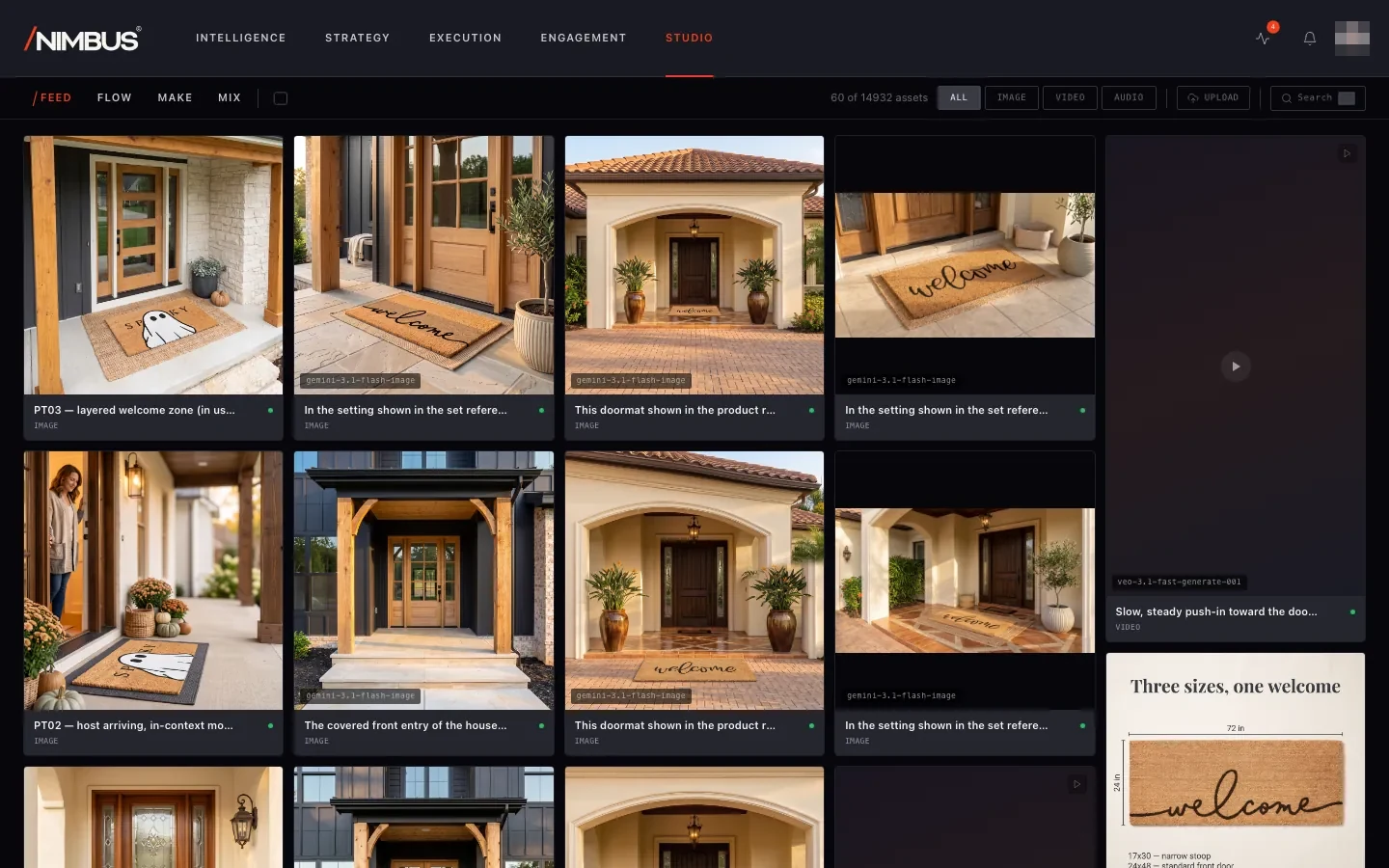
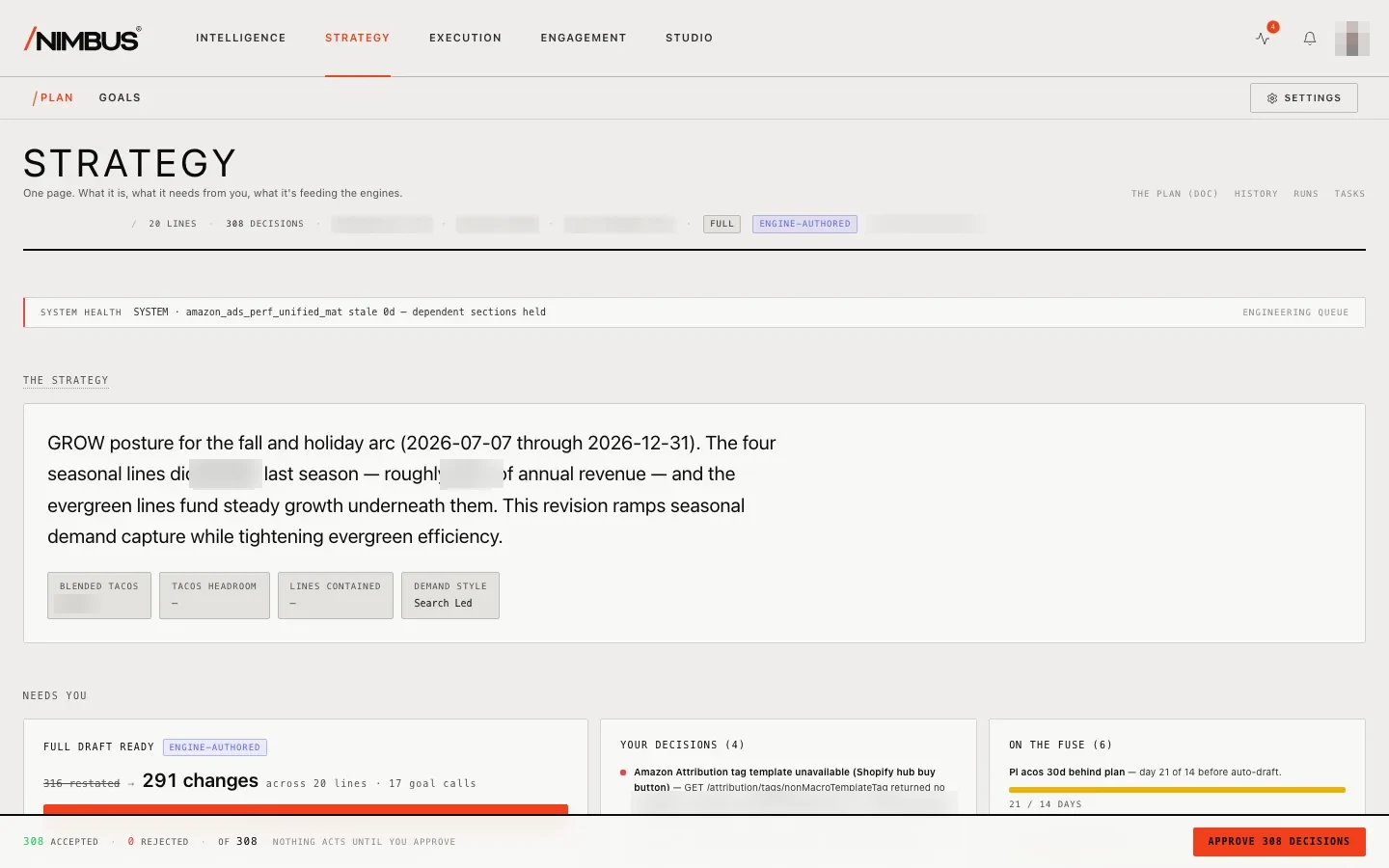
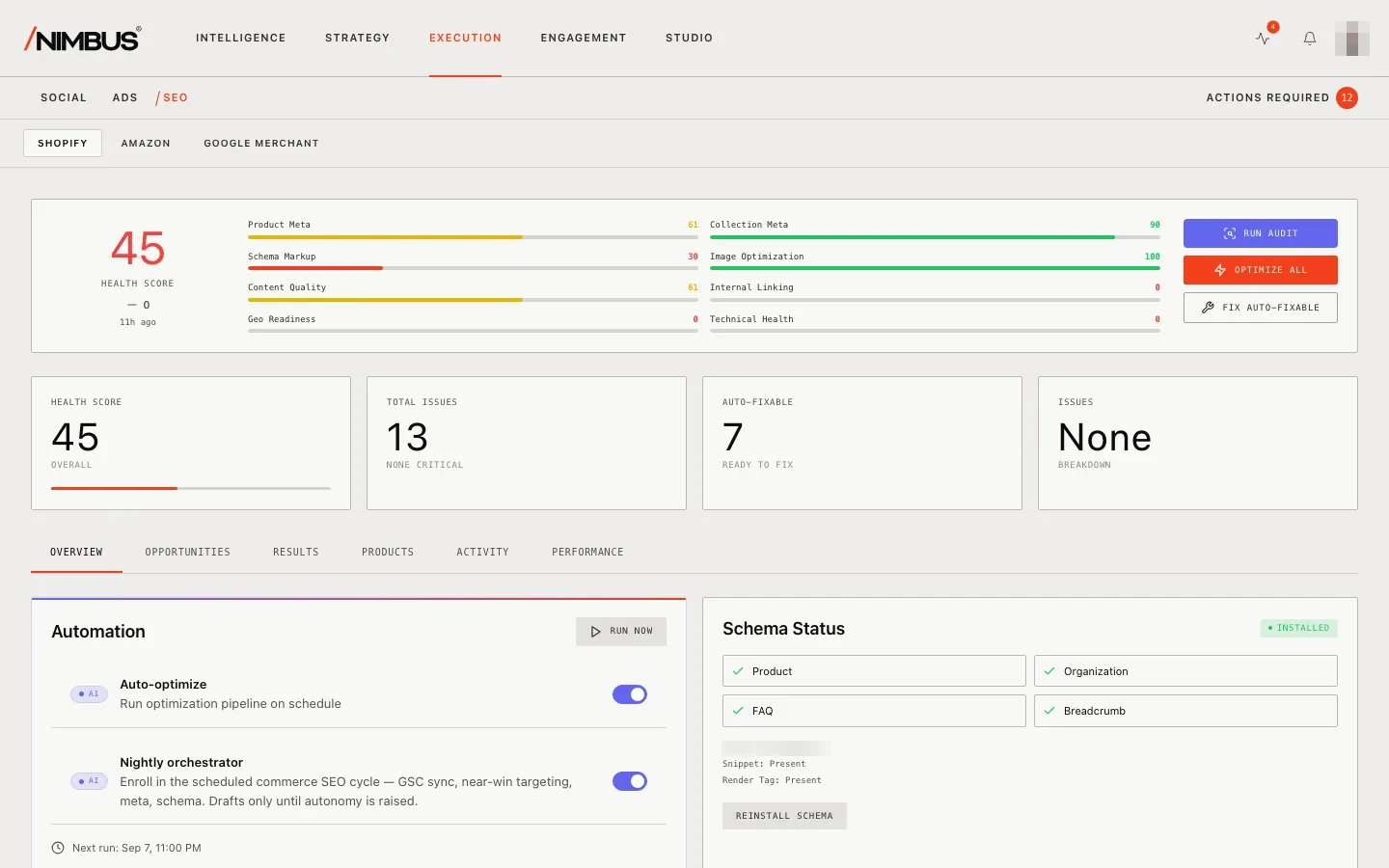
Marketing ran through tools that didn't know each other. Content generators without the brand. Ad platforms without the products. Schedulers without the goals. The knowledge lived in people's heads and left when they did.
Two intelligence layers, Brand DNA and Product DNA, sitting on a catalog where the SKU is the only truth. Every headline, image, and bid is generated from them, so voice and product facts can't drift.
A strategy engine plans the week. Bid, budget, and campaign engines close the loop on live Amazon, Meta, and Google accounts: shadow mode first, statistical winner detection, auto-revert on regression. Humans approve the decisions, not the drafts.
Deploying several times a day across commerce, service, and media tenants. A silent BigQuery dedup that swallowed half the order lines, a cross-tenant catalog leak, a wedged Cloud Run rollout: each one diagnosed, fixed, and written into the system as a rule.
Next.js 15, React 19, TypeScript. Postgres for the catalog, Firestore for jobs, BigQuery as the warehouse. Vertex AI: Claude, Gemini, Imagen, Veo, Lyria. Cloud Run, Cloud Functions, Scheduler, Pub/Sub. About 1.45 million lines of TypeScript.
Screens are from the production app on an operating tenant. Revenue, spend, tenant names, and account identifiers are redacted.
reconciled
Several seller accounts, six inventory buckets, three sets of books, and dozens of Amazon reports. None of them agreed. Veypar is the one number that agrees with itself.
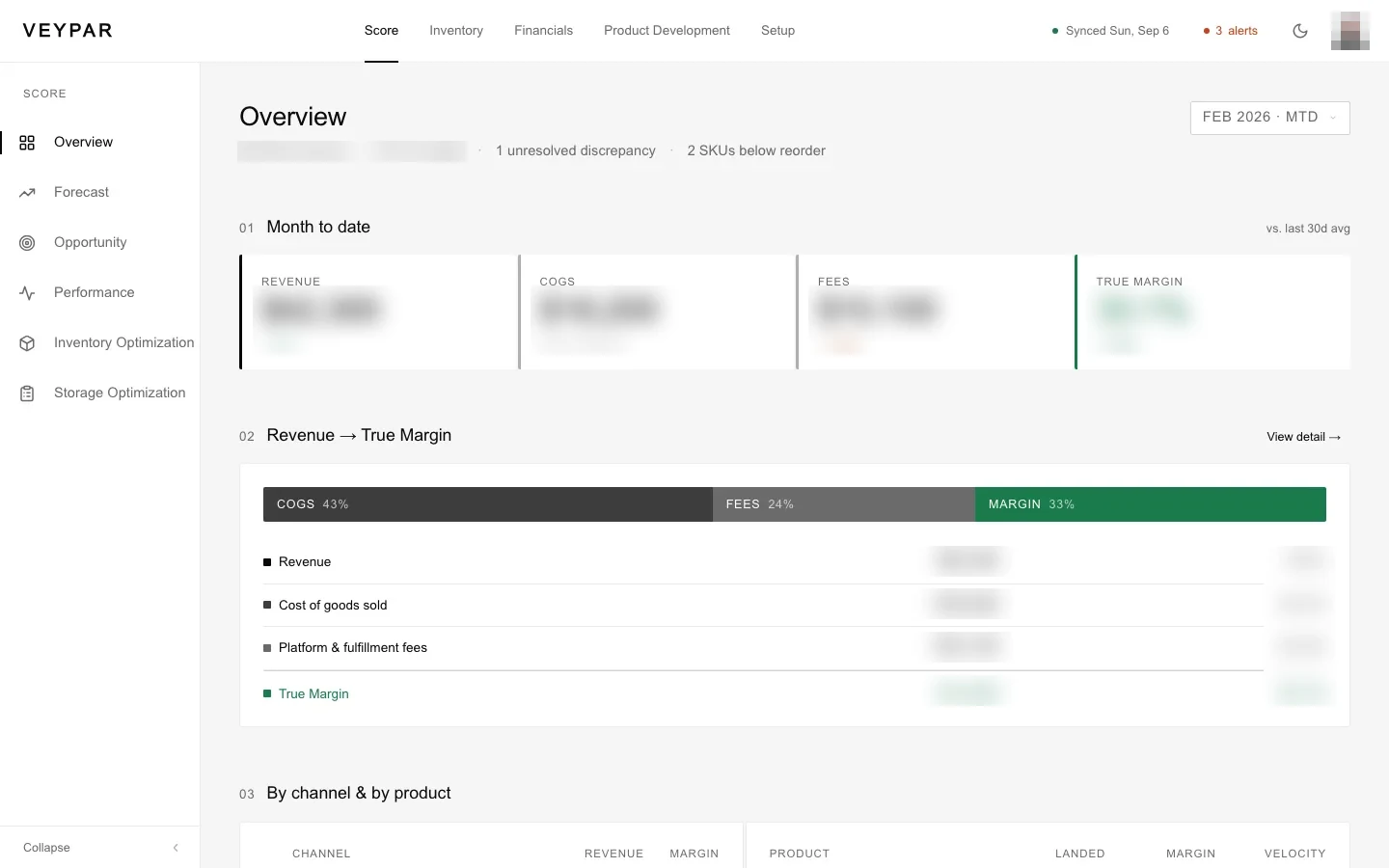
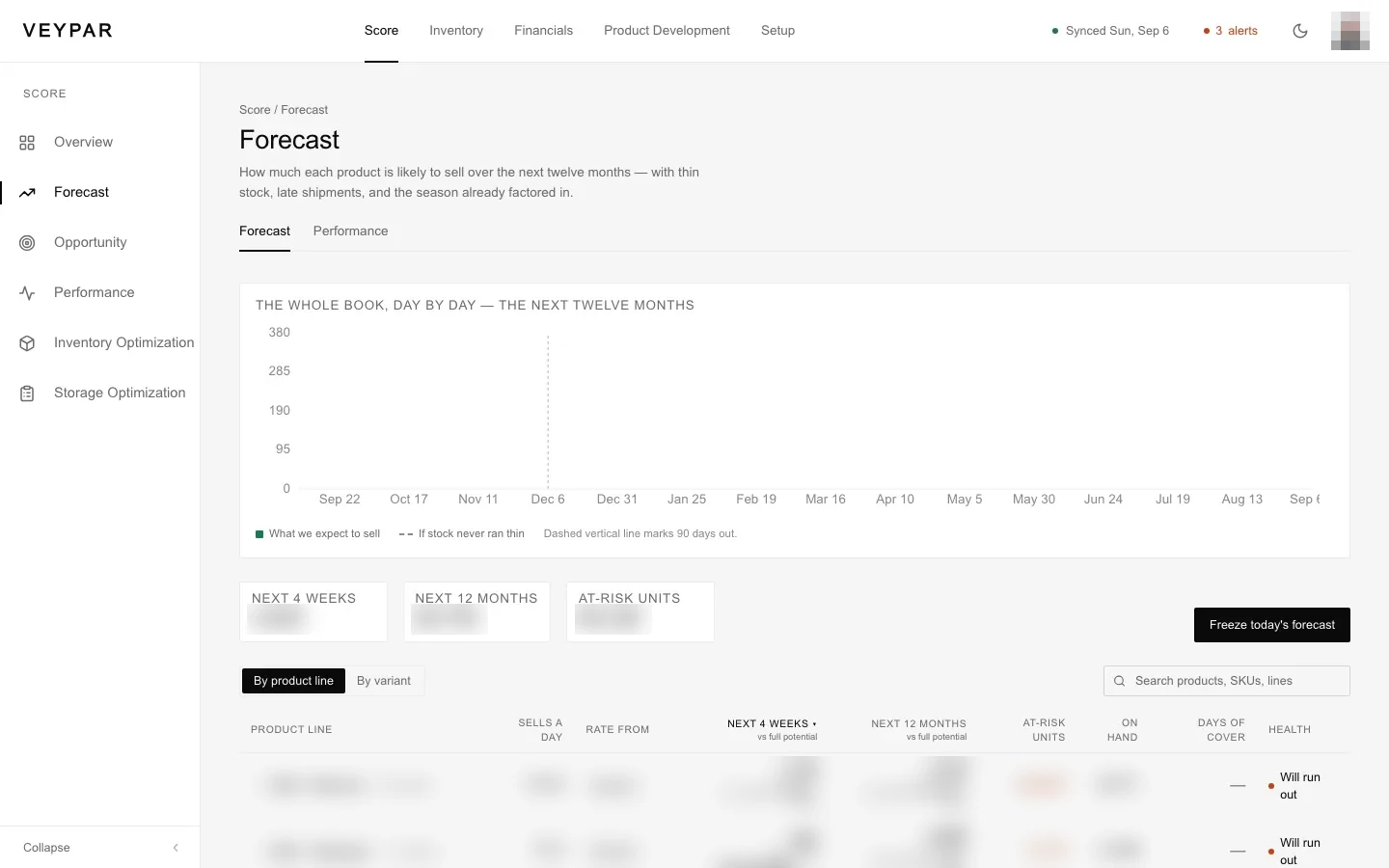
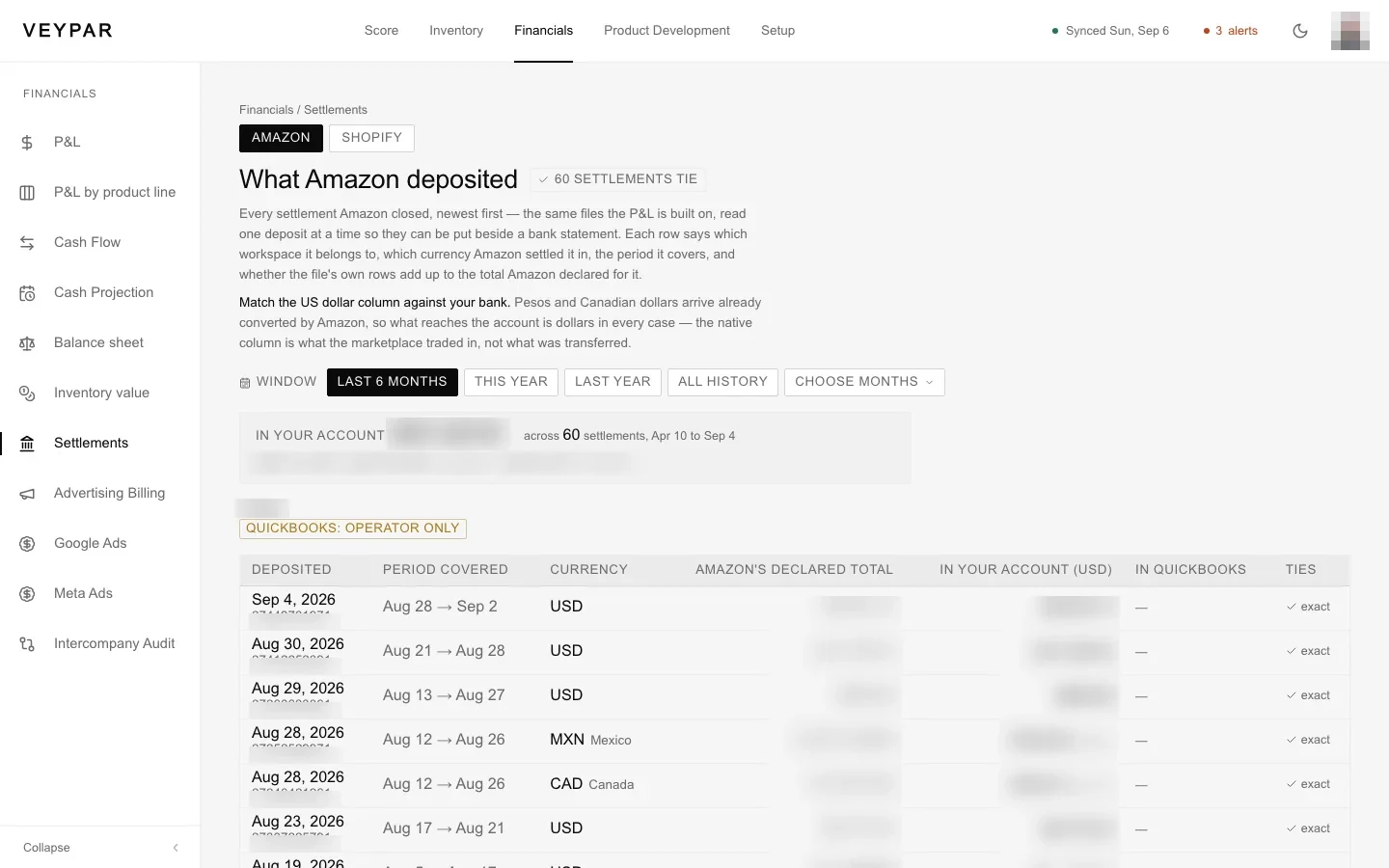
The truth about units and money lived in SP-API reports, Seller Central screens, QuickBooks company files, and spreadsheets. Some work, like FBA measurement disputes, has no API at all. A person clicked through it or it didn't happen.
Postgres for operations, BigQuery for truth, one workspace per seller account and every query scoped to it. Each ledger event is cross-checked against an independent report at the right grain and time zone. Drift is shown on a page, not hidden in a query.
Settlements, ledger, and ad spend become forecast, opportunity, and optimization verdicts. Forecasts freeze weekly and are graded against what happened. Settlements and Shopify payouts are checked against the QuickBooks landing account, then pushed as three-leg intercompany entries.
A work runner on the operator's own machine claims a case and opens a Claude Code session in the operator's signed-in browser, one account at a time. A containerized browser host does the same for agents, with a live view for humans. The human leaves the keyboard, not the account.
A dedup that hid up to 15% of shipments. Ad spend under-counted by a fifth through an empty mapping column. A browser that never flushed its cookies on restart. Each found by reconciling, each closed with a guard.
Next.js 15, React 19, TypeScript. PostgreSQL 16 on Cloud SQL, BigQuery, Firebase. Cloud KMS for tokens. QuickBooks, Amazon SP-API and Ads, Shopify, Google and Meta Ads. An MCP server with dry-run and idempotency on every write.
Screens are from the production app. Amounts, identifiers, product lines, and workspace names are redacted.
every write gated
Agents finish real work. Until now it landed nowhere. Matrix BOS puts strategy, execution, money, and people on one data model, with agents as principals and humans holding the pen.
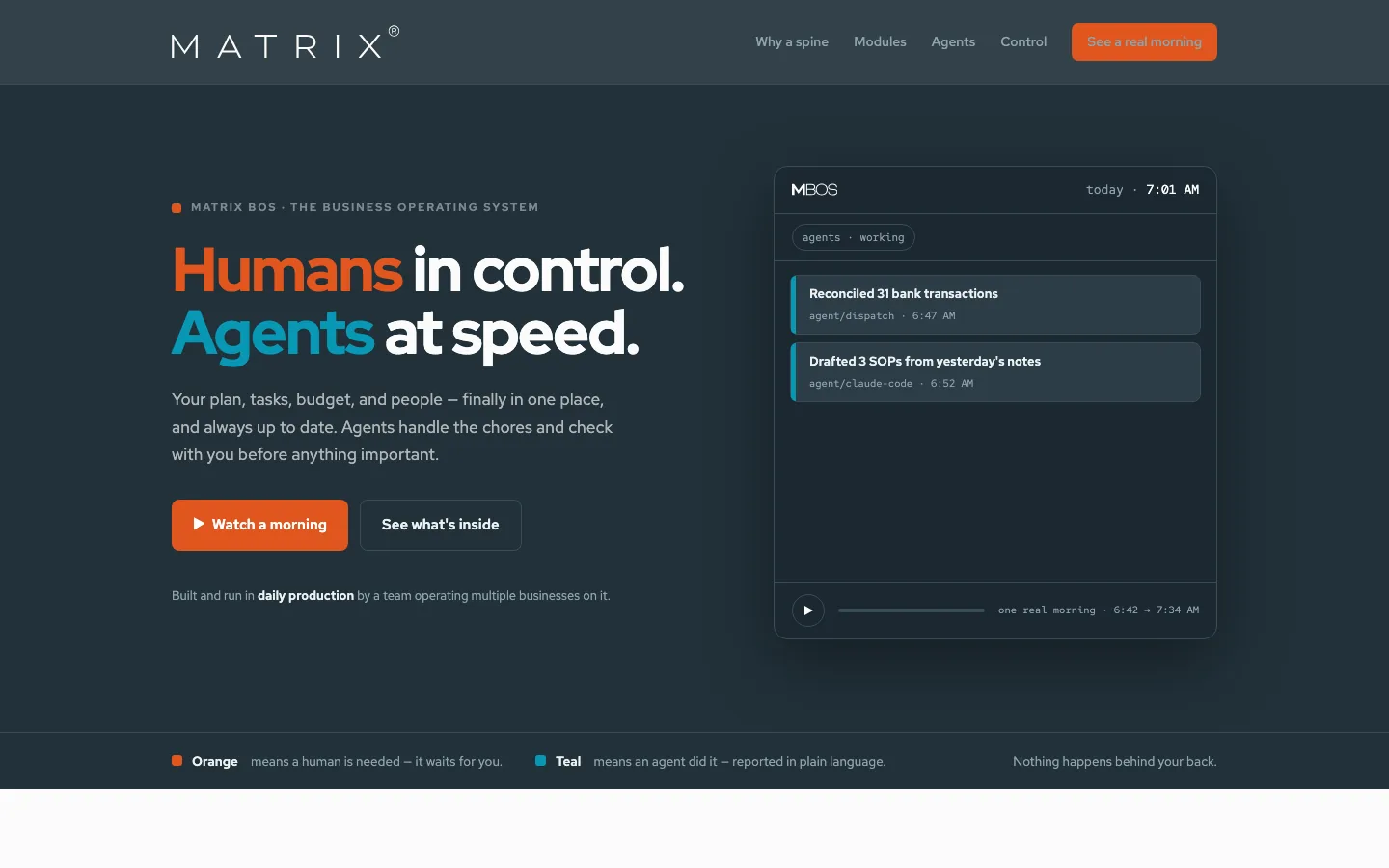
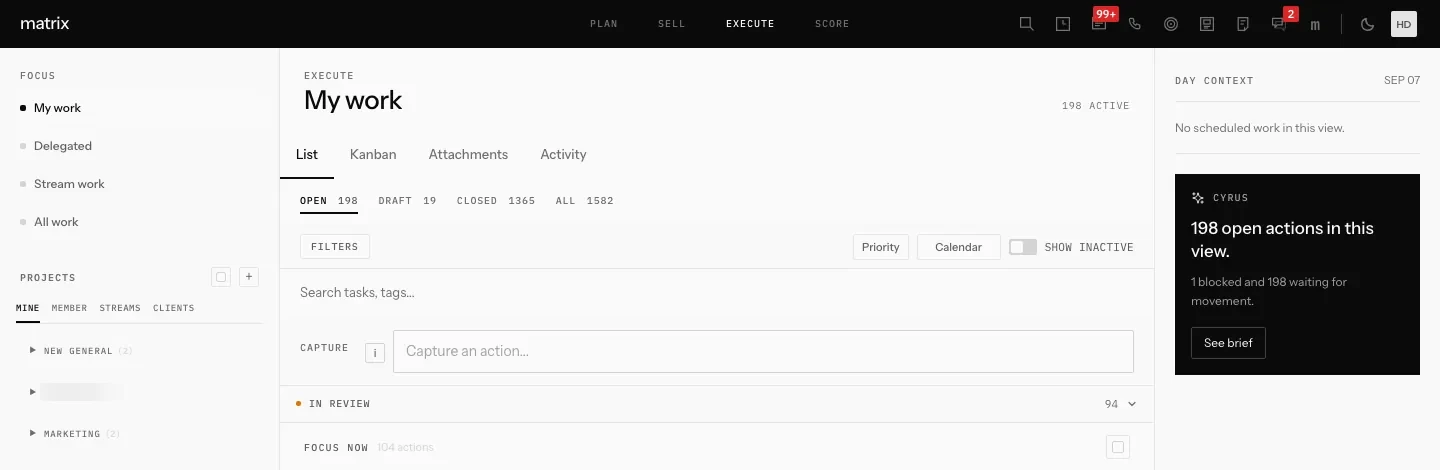
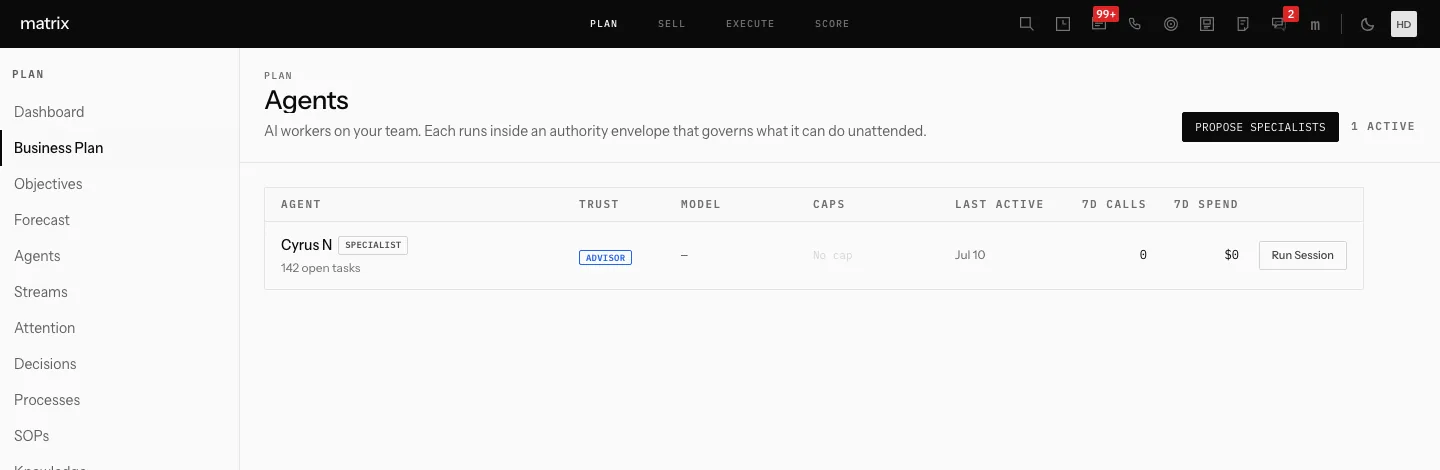
Claude Code, Cowork, and Dispatch complete work, and nothing tracks it. Priorities live in someone's head instead of a system an agent can read. Plans and SOPs scatter across tools. Blocked items stall silently. Machine speed becomes chaos.
Business plan, streams and tasks, budget and books, people and time off, threads and phones. Eight modules on one data model, row-level tenancy by organization, roles enforced server-side. Every desktop capability has a mobile counterpart.
An agent is a principal with an authority envelope. Inside it, it acts. Outside it, the write becomes a decision request a human approves before anything runs. Ember means a human is needed. Surf means an agent did this. The color tells you who.
Daily production across the Resilien businesses. An agent named Cyrus runs hourly and wakes on assignment, writing standups, filing handoffs, storing what it learned for the next session.
A cron that fired daily and made zero tasks with no error, two bugs deep. A sign-in that broke only for new users because two copies of one library disagreed. A deploy that failed for six weeks behind a port timeout. Found, fixed, documented.
Next.js 15, React 19, TypeScript. PostgreSQL 16 on Cloud SQL, Firebase for auth, realtime, and push. Vertex AI and the Anthropic SDK. Model Context Protocol. Twilio voice and SMS, Google Workspace, QuickBooks, Stripe.
Screens are from the production app and public site. Client and portfolio names are redacted.
on one chassis
Amazon exposes a seller's data across dozens of report types, several APIs, and a separate ad stream. We were paying a vendor for an opaque slice of it. Conduvit is the owned pipe: every Amazon signal, one warehouse, one table name per domain.
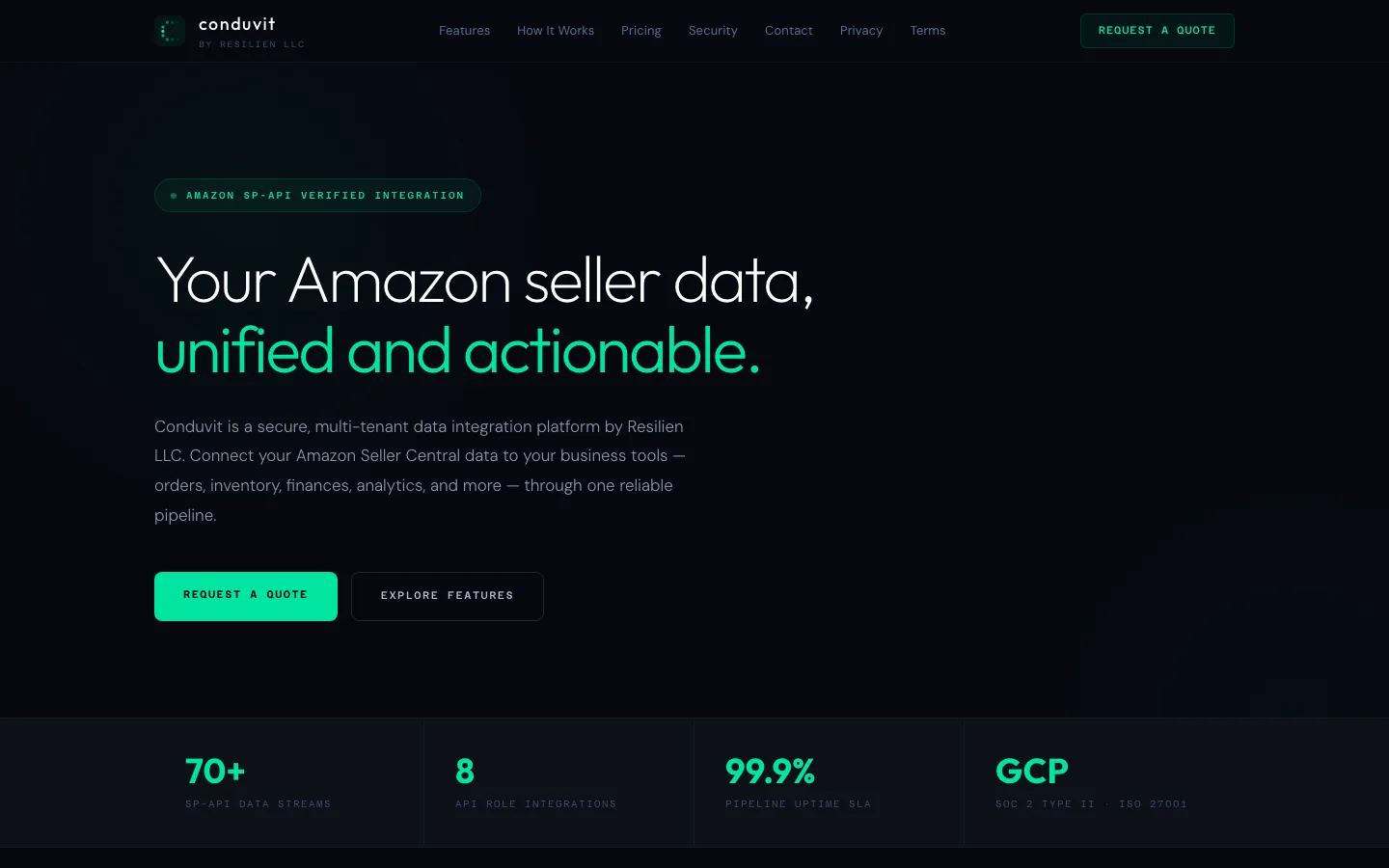
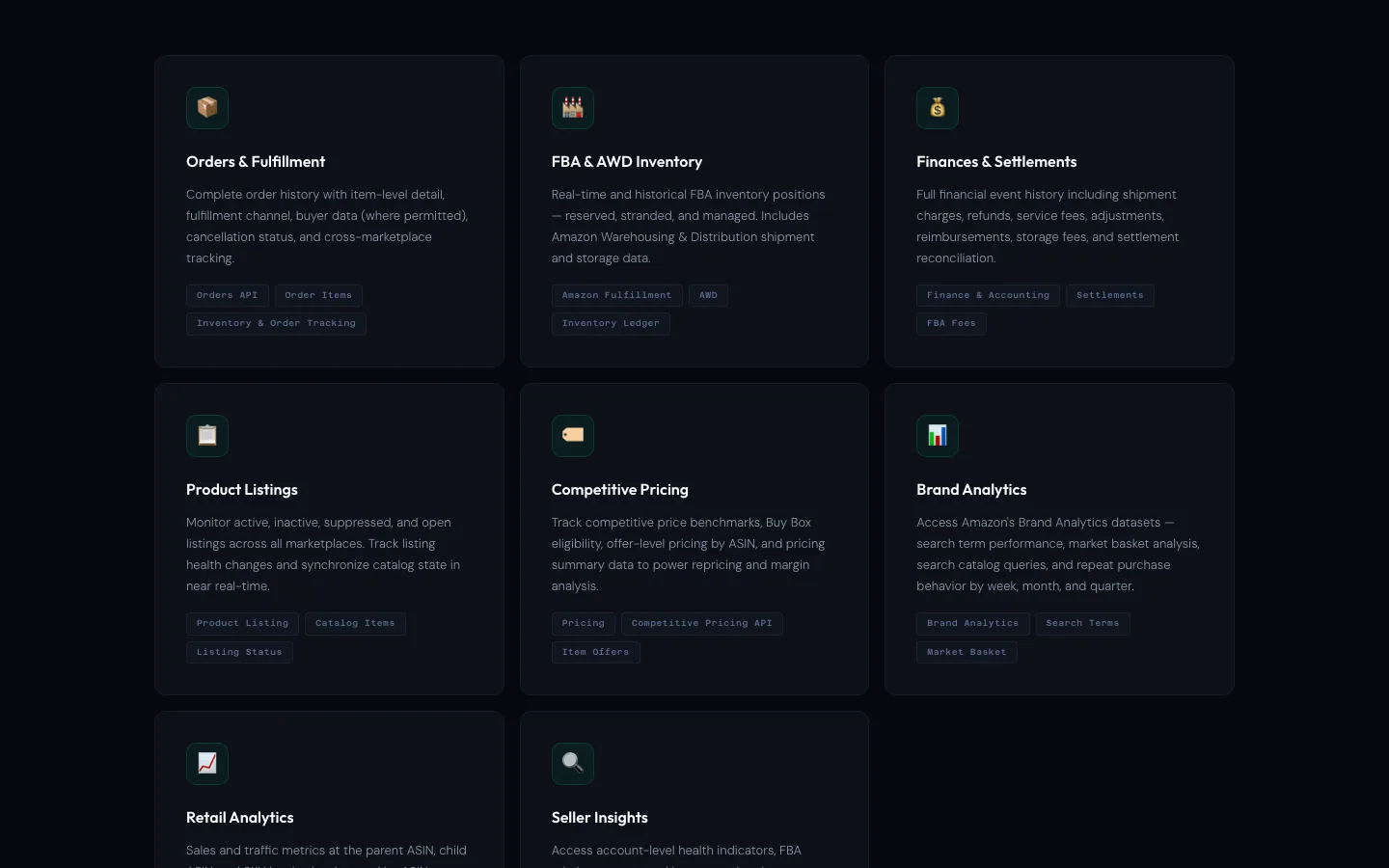
TSV here, JSON there, an event stream over there, each with its own rate limits. A third-party feed that was incomplete and opaque. Every internal app re-implementing its own Amazon integration and holding its own credentials.
A single Python service pattern: Cloud Scheduler posts a cohort, the puller creates the report, polls, downloads, parses through a per-report column config, and streams rows into partitioned, clustered tables with full-row hashes. A new SP-API track ships in days. Eighteen have.
A Parquet conversion was silently dropping twenty-plus fields and doubling reported ad spend. We rebuilt the route as raw JSON straight through Firehose, dual-subscribed during cutover, and removed about fifty legacy AWS resources when the old path went dark.
Union master views prefer first-party rows and anti-join the legacy bridge underneath. Nimbus and Veypar switched sources with zero schema changes. Nobody downstream noticed, which was the point.
Ads profiles map to tenants through an admin table joined into every view. Tokens sit encrypted in one connection service; product apps hold none. Public policies written to Amazon's Data Protection Policy. Warehouse spend cut 72% in one audit.
Python and Flask on Cloud Run. TypeScript and Hono for the connection service. BigQuery with Data Transfer Service and scheduled materializations. Kinesis Firehose, S3, Terraform. Prisma on Cloud SQL Postgres. GitHub Actions with path-filtered deploys per service.
Diagram drawn from the service map. The console is not yet public; the site is.
behind one router
Generic AI video makes one good clip. By episode ten the characters, the world, and the voice have drifted. Showrunner defines the vision once and produces every episode against it.



An episodic series means re-briefing a producer for every episode, and the cost compounds across script, casting, visuals, voice, music, edit, and publishing. Media, faith, and education brands need dozens of episodes a month and can afford neither the crew nor the inconsistency.
A creator answers one brief. Claude drafts the Blueprint, Gemini researches the source material with search grounding, the creator refines and approves, and the Blueprint locks. Visual style, narrator, content rules, music direction, and episode template are now injected into every shot.
Characters, locations, and voices are series-scoped assets: generated, approved, then propagated to every scene. Persistent voice IDs per role. Episode forty matches episode one because it was built from the same references.
Video costs five to ten times everything else, so the images gate comes first. Every step is quoted from the model registry against a prepaid balance. A bad shot is regenerated on its own, never the whole episode.
Veo, Kling, Seedance, Imagen, Gemini, ElevenLabs, Lyria, Claude, resolved by quality tier, pipeline type, and whether the shot needs lipsync. Eight-second clip ceilings become multi-minute episodes through a shot planner that lands cuts just before the beat.
TypeScript across the monorepo. Vertex AI and the Google GenAI SDK, Anthropic SDK, ElevenLabs, fal. Remotion and FFmpeg for assembly on Cloud Run. Prisma on Postgres, Firestore, Cloud Storage, Cloud Functions. Model Context Protocol.
Stills are production output from a live series, Zainab, Voice of Karbala: location plates and character references the pipeline generated, locked, and reused in every shot. Faces of the Ahlulbayt are never depicted, by the series' own content rules.
nightly, prices included
A shopper asks how many access points a 2,800-square-foot house with block walls needs. A generic chat app guesses. This one reads live stock, runs the installer's sizing math, prices the kit, and never invents a SKU.
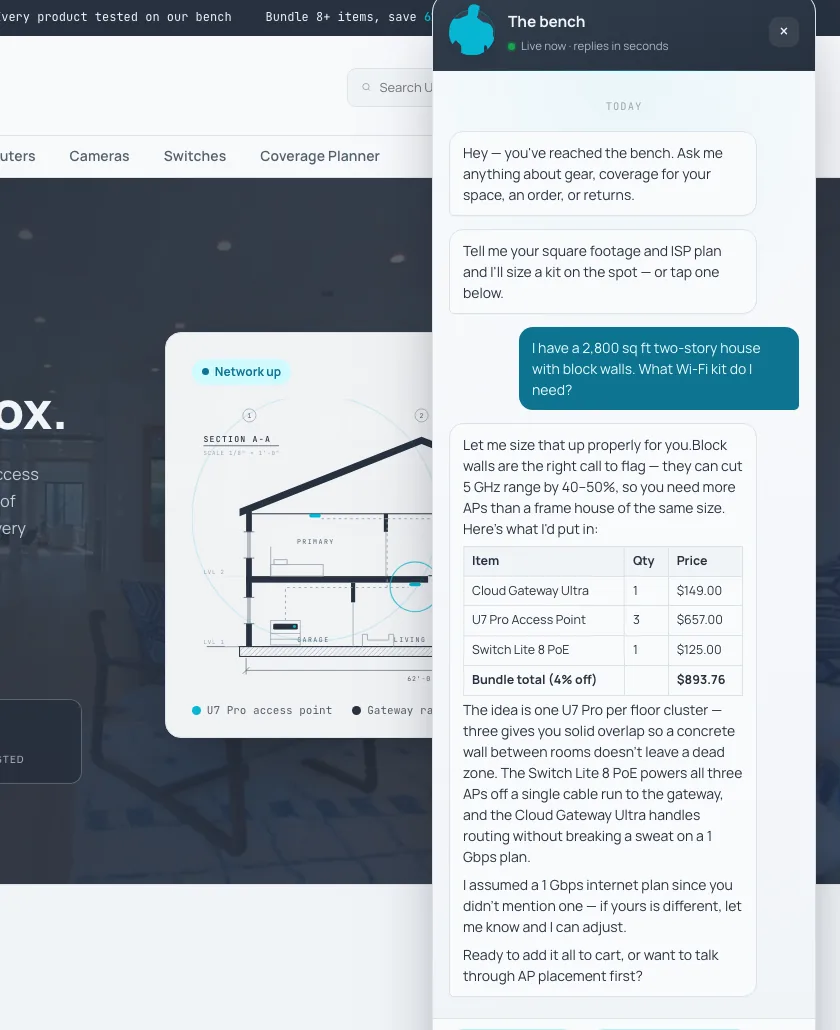
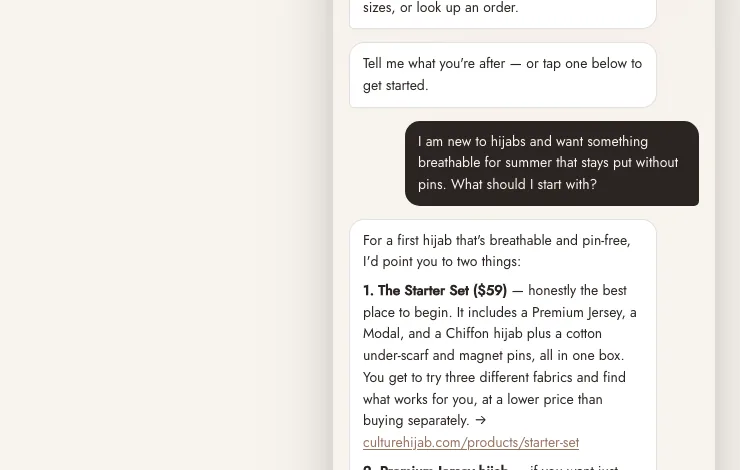
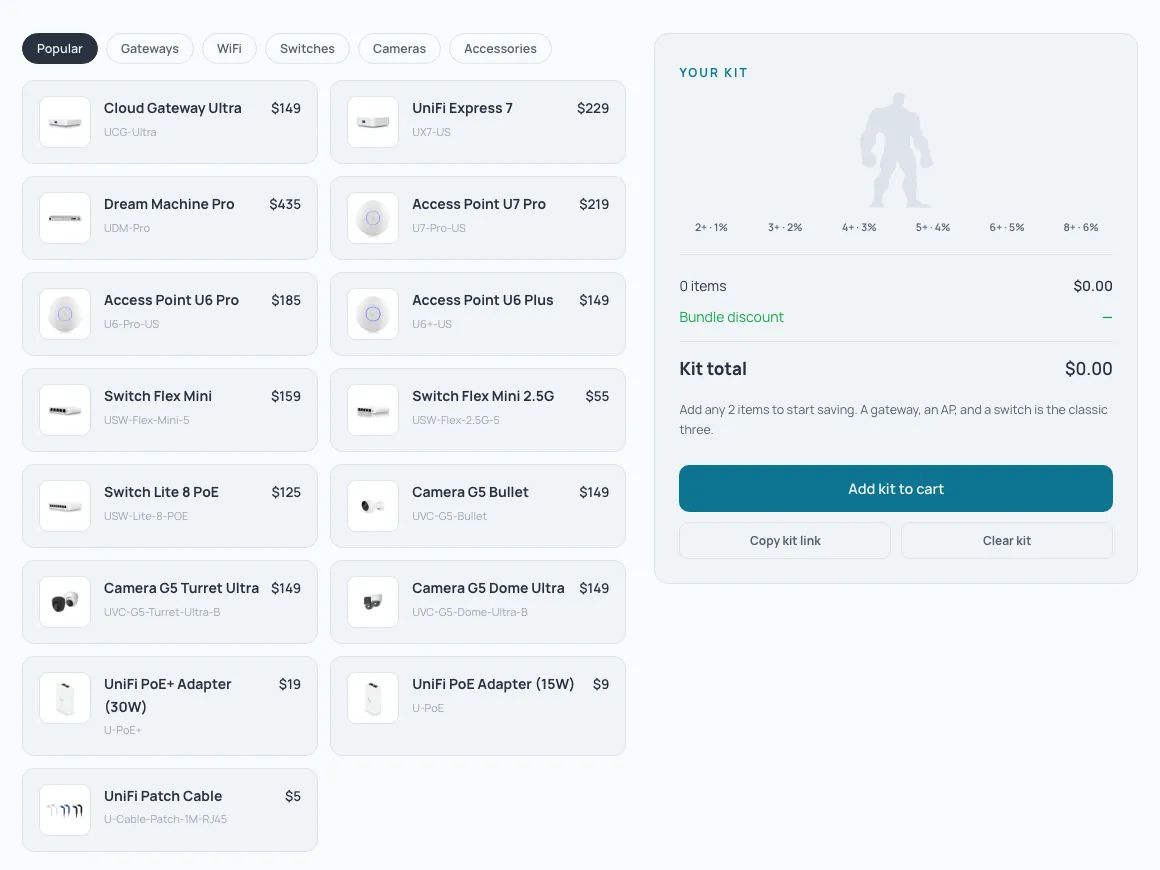
Networking shoppers don't know what a building needs; over- and under-buying both end in returns. Hijab colors and sizes live as separate products, so "does Onyx come in a mini" can't be answered from one record. One invented price or policy costs the trust the store runs on.
A Cloudflare Worker holds the key. Claude picks a tool: search products, get specs, check stock, look up an order behind a server-side email match, size a kit. The Worker runs it against Shopify and streams the answer back as it arrives. Every price, stock level, and spec is forced through a tool.
Type an address; a property record returns square footage, floors, and construction. One sizing engine, shared by the page and the chat, turns that into a gateway, a PoE switch, and an access-point count, then hands off to a builder that flags a PoE device with no PoE source. The planner says what it can't know.
The distributor blocks scripted requests, so a nightly job reads a browser-captured snapshot and refuses stale or undersized data. Quantities, MSRP-derived prices, and kit prices update safest-first. Sold-out pages stay live to capture demand; a waitlist emails the moment the variant flips.
The Worker ported to Culture Hijab with a color-group tool that walks the metafields stitching sibling products together, a warmer prompt, per-IP rate limiting, and privacy-safe metrics. Plus native bundles, a one-tap post-purchase add-on, and a wishlist that follows guests into their account.
Cloudflare Workers, D1, KV, Cron Triggers. Anthropic Messages API with tool use, streaming, and prompt caching. Shopify Storefront and Admin GraphQL, checkout UI extensions, Liquid. Rentcast and Google Places. Resend.
Live storefronts with the chat widgets open mid-conversation.